Projected Tax Revenue and Enforcement Savings from Nationwide Cannabis Legalisation in Australia
Key Assumptions
- Nationwide Legalization: Recreational cannabis is legalized across all Australian states and territories (medicinal use is already legal). A uniform federal regulatory framework is assumed. A new Australian Cannabis Agency (per PBO proposals) would oversee licensing, production, and sales.
- Market Transition Period: It will take several years for the legal market to displace the black market. We assume a rapid uptake similar to Canada’s experience – e.g. ~25–30% of cannabis consumption shifting to legal channels in the first year, ~60–70% by the second year, and ~90%+ by the third year as availability improves and prices undercut illicit dealers . By about year 3, the market reaches stabilization, with most demand met by legal, regulated sales.
- Consumer Usage and Demand: Approximately 10% of Australian adults (~2 million people) are regular cannabis users. The Parliamentary Budget Office (PBO) estimates average consumption at about 2.8–3 grams per week per user (around 145 grams per year). Legalization could induce a modest initial increase in overall cannabis use (estimated ~15% bump in the first year) as some new consumers enter the market or existing users consume more openly . After this initial surge, growth in demand is assumed to track population growth (~1–2% per year).
- Pricing: Legal retail pricing is set to compete with or undercut black market prices. Currently, illicit cannabis in Australia ranges about $10–15 per gram. We assume an average legal retail price of ~$14 per gram, comparable to Canada’s legal market and on par with the illicit price . This price includes taxes and is intended to draw consumers into the regulated market by offering similar or better value. Producers and retailers operate on thin margins initially, and prices may gradually fall as the industry scales up.
- Taxation Model: Cannabis would be taxed in a manner analogous to alcohol and tobacco – via a combination of GST (10%), a special excise/sales tax on cannabis, and business taxes on profits. The PBO’s model for the Greens’ proposal uses a 15% federal excise on cannabis sales (applied on top of the base price before GST or equivalently ~15% of the final sale price) . In addition, the 10% GST applies to cannabis products nationwide (noting GST revenue is ultimately returned to states). Corporate income tax (at 25–30%) would apply to licensed producers and retailers’ profits. Licensing fees (application and annual fees for growers and retailers) are assumed but contribute only a minor amount (several million dollars annually) relative to sales taxes.
- Enforcement Costs and Savings: Currently, prohibiting cannabis incurs substantial law enforcement and justice costs. Policing, courts, and imprisonment for cannabis offenses cost Australia on the order of $1.7–2.1 billion per year . (In 2015–16, for example, over $1.7 billion was spent enforcing cannabis laws, including ~$475M on police, ~$62M on courts, ~$52M on legal aid, and a whopping $1.1 billion on incarceration of cannabis offenders .) About 90% of cannabis-related arrests are for minor possession/use, not trafficking . Legalization would virtually eliminate these costs – police would no longer expend resources on arresting users, courts would not prosecute minor cannabis offenses, and prisons would not house people for cannabis alone. A small fraction of prior costs might remain to police any illicit grow-ops or unlicensed sales that persist, but this is expected to be minimal once a legal market is established (similar to Canada, where only ~4% of consumers still resort to unregulated sources after a few years of legalization ). We assume that in the long run at least ~90% of current cannabis enforcement costs are saved (the remainder representing residual enforcement against any black-market activities or diversion of resources to other policing priorities). These “savings” could be reallocated to other law enforcement needs or represent budget relief. (Even just decriminalizing use/possession was estimated to save about $850 million annually in Australia – full legalization saves more by also undermining the black market.)
- Regulatory Costs: Implementing legalization does incur some government costs (setting up the cannabis agency, monitoring compliance, public education, etc.). We account for new regulatory expenditures on the order of ~$100–$150 million per year in the early years (for instance, the PBO estimated about $1.2 billion in total new expenses over 10 years for administration and enforcement of the legal market ). These costs are far lower than the enforcement savings, and over time economies of scale could reduce per-year regulatory costs. Our “savings” figures below are net of these new regulatory costs, reflecting the net relief to police, courts, and corrections budgets.

Projected Tax Revenue from Legal Cannabis
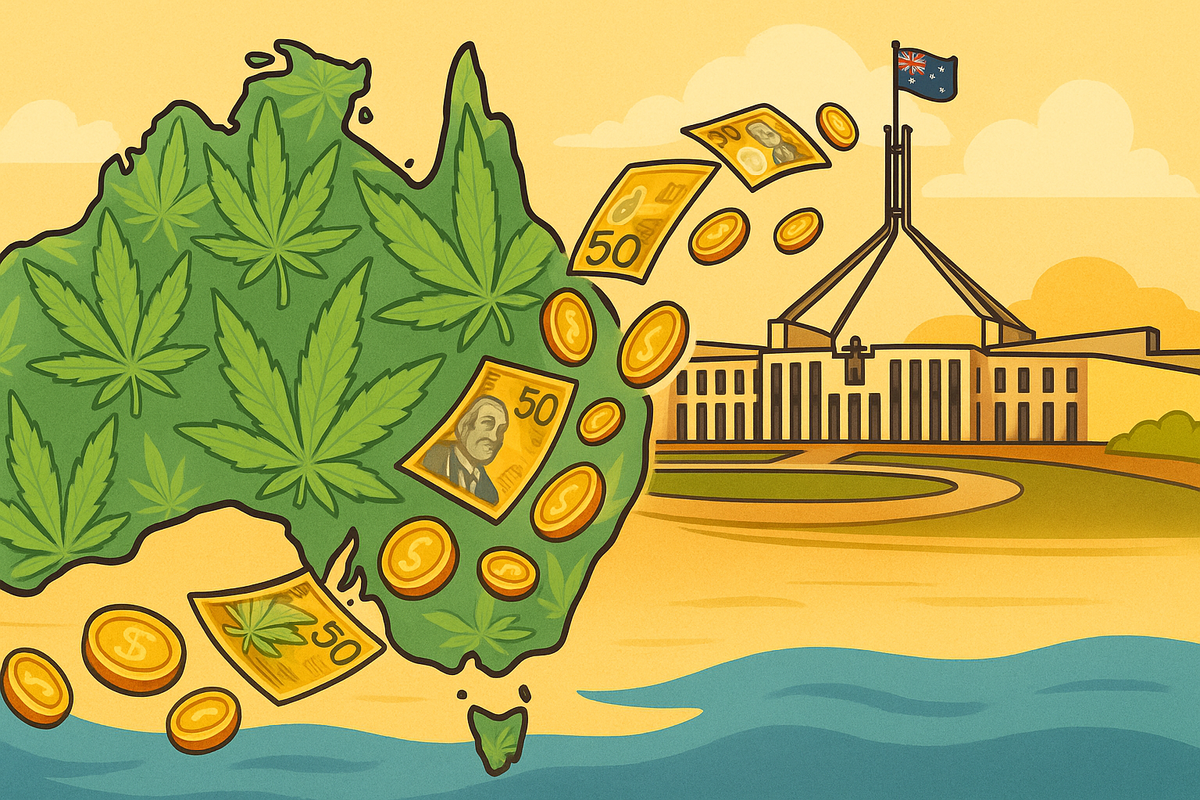
Using the above assumptions, we can estimate federal tax revenues from legal cannabis sales. In a steady-state year, roughly 300–350 tonnes of cannabis might be sold through legal channels (given ~2 million regular users at ~0.15 kg each per year). At an average retail price of ~$14/gram, annual consumer spending would be on the order of $4.0–4.5 billion. The government’s take from this consists of:
- GST: 10% GST on the pre-tax price. For a $14 final price, the base price is $12.73 and GST is $1.27. Across $4+ billion in sales, GST yields roughly $400 million per year.
- Excise (Cannabis Tax): 15% excise on cannabis sales (modeled after alcohol/tobacco excise). At $14/gram retail, this contributes about $1.80 per gram in tax. Across total sales, excise revenue is about $600 million per year. (If implemented as 15% of the final sale, excise would be ~$600M; if 15% of pre-GST price, very similar outcome.)
- Corporate Tax: Businesses in the cannabis supply chain (growers, processors, retailers) will owe corporate income tax on their net profits. Assuming a combined industry profit margin of ~15% on $4.3B in sales (approximately $645M in profit) and a 25–30% tax rate, corporate tax could add roughly $160–$195 million annually. We round this to approximately $180 million per year in steady state.
- Licensing Fees: If, for example, 100 production licenses (tiered by size) and a few hundred retail licenses are issued, one-time application and annual fees might yield on the order of $5–10 million per year in total. This is relatively negligible next to the above taxes.
Summing these components, steady-state federal revenue from cannabis is on the order of $1.2–1.3 billion per year. This aligns with independent Parliamentary Budget Office costings that, after revision to more realistic usage assumptions, project about $11 billion over 10 years in new public revenue – roughly $1.1B per year on average. However, the PBO notes that initial years will be lower as the market ramps up, and about $700 million per year is expected once the market matures . The lower $700M figure represents the net annual gain to the federal budget in a stable year after accounting for regulatory costs and a somewhat conservative uptake of legal sales. Notably, the PBO’s latest model assumed much lower weekly usage per user (2.8g) than earlier forecasts and a lower retail price (~$14/gram instead of $17) to ensure the legal market captures consumers . These adjustments brought the revenue estimates down to more realistic levels (from an overly optimistic $28B/decade projected earlier, down to ~$11B/decade) .
For our projection, we will use the PBO’s refined outlook: roughly $700 million annual tax revenue once fully up and running (with potential to grow beyond this as the market expands). The breakdown of this $700M might be roughly: ~$280M GST, ~$350M excise, ~$70M corporate tax (net – since corporate tax doesn’t directly show in PBO’s budget bottom line estimate), which together yield the $700M range (these figures are illustrative; actual splits may vary).
Projected Savings in Policing and Criminal Justice
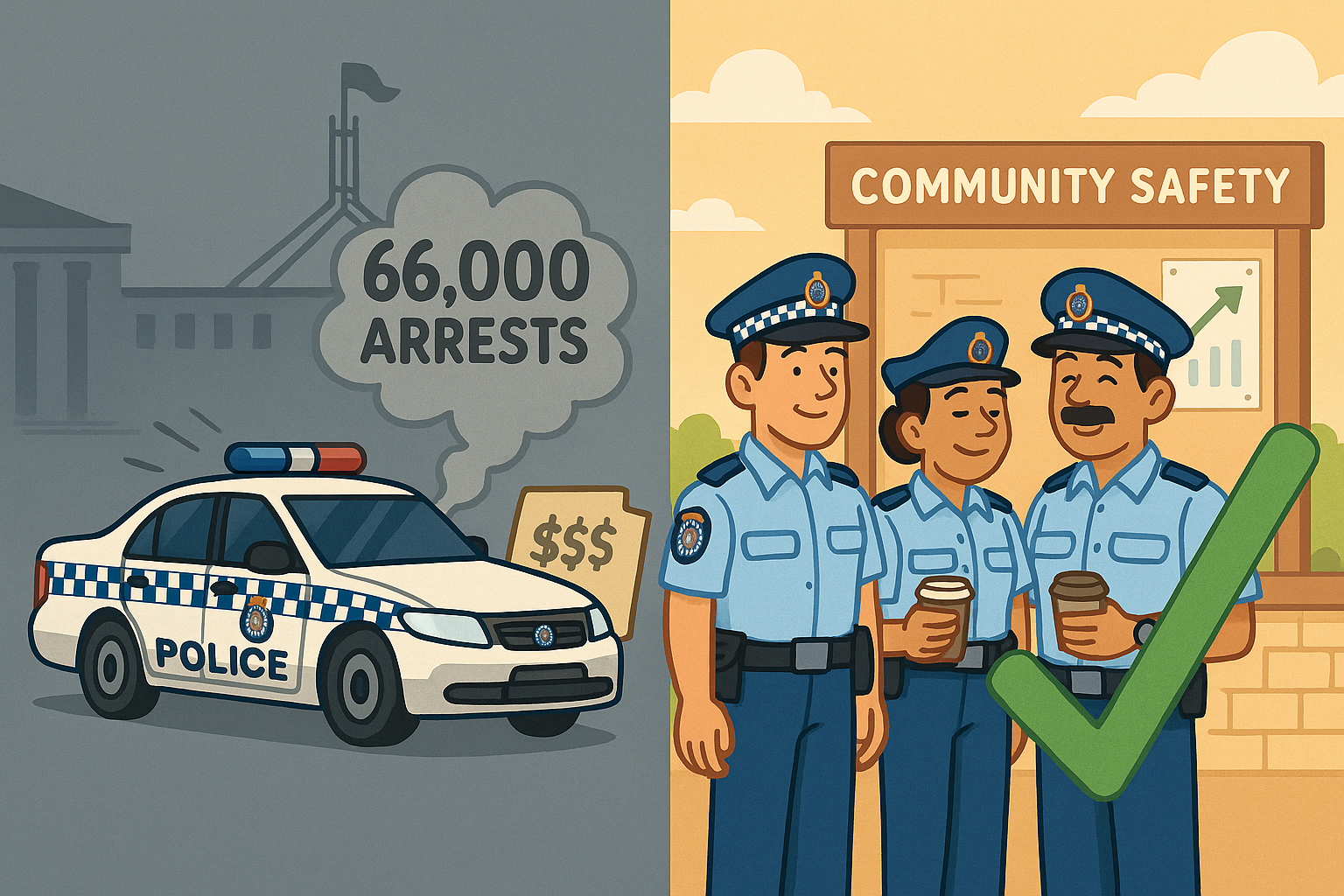
On the cost side, full legalization yields significant savings (or resource reallocation) for law enforcement and the justice system. As noted, Australia currently spends around $1.7–2.0 billion each year enforcing cannabis prohibition . These costs include: arrests by state police (over 66,000 cannabis arrests in 2020–21, mostly for personal use), court cases, and incarceration (an estimated $1.1 billion per year on imprisoning people for cannabis offenses ). Under legalization, possession and use are no longer offenses, and licensed production/sales operate in the open. Thus:
- Police save the time and expense of tens of thousands of cannabis-related arrests and investigations annually. Police can be redeployed to more serious crimes. (The Australian Federal Police and state police drug units would likely reduce operations targeting cannabis – the PBO anticipated a reduction in AFP departmental costs under a legal regime.)
- Courts & Legal System avoid processing minor cannabis cases. This frees up court time, legal aid, prosecutors, etc., yielding savings in the tens of millions annually.
- Corrections no longer need to incarcerate people for cannabis alone. Over time, as those previously serving sentences for cannabis-related crimes are released or not replaced by new offenders, hundreds of millions in prison costs can be saved. (Private prisons in 2015–16 received about $1.1B for housing drug offenders, much of which was for cannabis ; those contracts could be reduced accordingly.)
In total, once the transition is complete, we estimate on the order of $1.5–1.8 billion per year in gross savings to law enforcement and justice systems. A portion of this (perhaps 5–10%) would still be used for regulating the legal market and policing any remaining illicit activity (e.g. unlicensed trafficking or sales to minors). For example, dedicated cannabis regulators and compliance inspectors will replace some of the role of police narcotics units. Additionally, some police resources might shift toward other drug enforcement (as noted by the PBO, the AFP might reallocate freed-up resources to target other illicit substances rather than simply cut the budget). Taking these factors into account, we project a net enforcement cost reduction of roughly $1.2–1.5 billion annually in steady state. This is consistent with the Penington Institute’s finding that ~$1.7B is spent on cannabis prohibition and that even decriminalization (which still leaves the black market intact) could save ~$850M/year . Full legalization goes further by largely dismantling the illicit trade, yielding savings approaching the full current expenditure (minus some residual oversight costs).
Multi-Year Revenue and Savings Projections
Taking the above into account, the table below shows an illustrative projection over the first five years of nationwide legalization. This covers the early adoption phase (Years 1–2) through the market stabilization phase (by Year 3 and beyond). All figures are in AUD millions.
Year | Tax Revenue (Federal) | Enforcement Savings (All Agencies) |
|---|---|---|
Year 1 | ~$200M – $250M | ~$850M (initial savings as arrests drop; black market still active) |
Year 2 | ~$500M | ~$1,200M – $1,300M (legal market expands, enforcement further reduced) |
Year 3 | ~$700M | ~$1,500M (market nears full scale; major policing cost relief) |
Year 4 | ~$730M | ~$1,600M |
Year 5 | ~$750M | ~$1,600M |
Table: Estimated cannabis-related tax revenues and law enforcement cost savings in the first five years after legalization. Year 3 is roughly when the market reaches steady state in this model. Figures are rounded.
Notes: By Year 3, the legal industry is assumed to be fully operational nationwide (hundreds of dispensaries and growers licensed, robust consumer uptake), yielding around $700 million per year in tax receipts . Concurrently, annual policing/judicial savings reach approximately $1.5–1.6 billion as the vast majority of cannabis enforcement is no longer necessary. In Years 1–2, revenues are lower due to the time needed to establish production and retail networks (as seen in Canada’s rollout) and for users to transition from illicit suppliers. Enforcement savings accrue quickly (most personal-use arrests stop immediately), but not 100% on day one – police still monitor unlicensed activity especially in the transition, and legacy legal cases wind down over time. By Year 4–5, the market is truly mature. We show a slight growth in revenue in years 4–5 (e.g. due to population growth and increased legal market share, including possibly cannabis tourism sales), but essentially the figures plateau around these steady-state values.
Steady-State Annual Impact
Once the system is fully up and running (beyond the initial adjustment period), Australia can expect approximately $700 million per year in additional federal tax revenue from legal cannabis sales . This consists of excise taxes, GST, and corporate taxes derived from the cannabis industry. On the cost side, roughly $1.5–1.6 billion per year in law enforcement and criminal justice resources can be redirected or saved, as police and courts no longer have to handle the bulk of cannabis-related offenses. In other words, legalization delivers a significant net positive fiscal impact: billions of dollars per year in combined benefit when adding new revenue and budget savings.
These estimates are in line with reputable analyses. For example, the Parliamentary Budget Office’s costing for a nationwide legalization scheme found ~$4.0 billion net boost to the budget over the first four years, and around $28 billion in total public revenue and savings over a decade was projected by Greens Senator David Shoebridge (a figure since revised downward to ~$11B in revenue alone, as noted, with more cautious assumptions). The bottom line is that legalizing cannabis in Australia is expected to raise on the order of hundreds of millions in new taxes annually and save over a billion dollars annually in avoided law enforcement costs, once the program is in full swing. These funds could be reinvested into public services (healthcare, education, drug treatment) or used to offset deficits , while the social benefits include eliminating tens of thousands of cannabis arrests and undermining organized crime’s $25 billion black market.
Sources: Official Parliamentary Budget Office (PBO) cannabis legalization costing reports; Australian Greens policy costings; Penington Institute Cannabis in Australia reports; ABC News and Guardian Australia reporting on cannabis revenue and enforcement data; Canadian market data (for uptake and pricing comparisons) Norml. Each estimate above is grounded in these sources and adjusted to 2025.